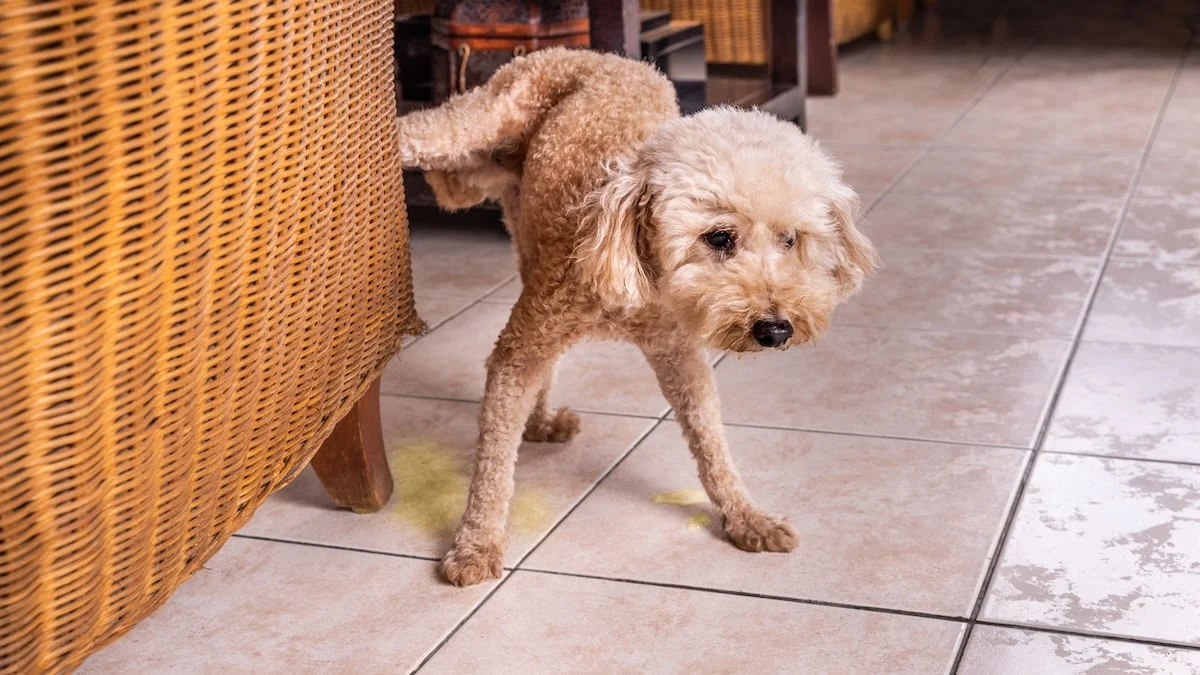
House training is probably the first real test of life with a new dog. Before you’ve figured out feeding schedules, before you’ve worked out the sleeping arrangements, before you’ve even had a chance to enjoy that new-puppy smell, you’re already on cleanup duty.
Most owners go into it thinking it won’t take that long. Some get lucky. Most don’t.
On its face, house training your dog is really pretty simple: your dog just has to be in the right place at the right time.
You and I both know that’s easier said than done.
Simple Doesn’t Mean Easy
Just because something is simple doesn’t mean it’s easy, and lots of owners struggle with house training. In fact, it’s one of the most common frustrations new dog owners face.
From the human perspective, potty training is a labor-intensive process. It requires close supervision, frequent potty breaks, consistency, patience, and a whole lot of cleaning up after accidents.
And when I say it takes time, I mean “time” in two different ways.
First, it takes hourly time out of your daily life. Walking your dog outside every two hours can be exhausting, especially when you’re also dealing with midnight wake-up calls and 2 a.m. potty trips.
Then there’s calendar time.
Before a puppy can become reliable, he has to develop both the mental maturity to understand where and when he is supposed to go, and the physical control over his muscles to actually hold it. That might not happen until five or six months of age, or even longer.
Small breed dogs may even take up to a year; with their fast metabolisms and smaller bladders, they simply have less physical capacity to hold it for very long.
Progress is rarely perfectly linear, either.
Many puppies improve for a week or two and then suddenly seem to regress, especially during growth spurts and developmental changes like teething.
Where You Get Your Dog Matters, Alot
If you get your dog from a good breeder (and not just a producer) then your dog will very likely have a good head start on the potty training. Typically, the breeder will as soon as the puppies are walking, will take them and mom outside in the yard for some sunshine.
There, they will toddle after their mother and get used to the feel of grass. She will demonstrate to them that grass is a good place to eliminate, and maybe even help along with that. And the puppies will develop a preference to using grass for basic needs.
Not All Puppies Start From the Same Place
What makes house training even trickier is that puppies don’t all start from the same place. Some face real disadvantages right out of the gate.
Pet store puppies, or shelter puppies that spent long periods confined in kennels or cages where they were forced to eat, sleep, and eliminate in the same small space, are harder to potty train because they never learned to separate living space from potty space. That wiring has to be undone before better habits can take hold.
Family pets that were raised in homes without consistent house training often struggle because they’ve already spent months practicing the wrong habits. Many have simply come to think of the carpet as an acceptable place to go. It takes longer for those dogs to catch on because the old habits have to be undone before better ones can take their place.
The Puppies That Get “Lost in the Noise”
And then there are the puppies that just get “lost in the noise.” Some are so easily distracted or overstimulated by everything they see, hear, and smell outside that they never fully settle down long enough to eliminate.
They become so busy investigating the world around them that they forget why they went outside in the first place — at least until they step back onto the quiet safety of your living room rug.
The Good News
The good news is that most house training problems aren’t permanent, and they usually aren’t caused by a stubborn or spiteful dog.
More often, they come down to supervision, routine, consistency, and preventing bad habits from becoming deeply ingrained.
A puppy that has too much freedom too soon is almost guaranteed to make mistakes. A puppy that is consistently guided to the right place at the right time usually begins improving steadily over time.
Stay tuned. This is the first in a series of posts on house training. In the coming articles, I’ll cover some of the most common mistakes owners make, the different ways puppies struggle, and how to make the process easier on both you and your dog.